

Written by webtechs

What To Do After Retirement | 19 Activities & Retirement Hobbies

You’ve worked your entire adult life and now you’re retiring and getting absolute control over what you do, when you do it, and how to spend your time.  Whether you’re looking for things to do when retired and bored or activities for retired couples we have what you’re searching for in this post.  Read through our list of things to do after retirement to enjoy all the opportunities that are waiting for you!

1. Travel

Retirement is a great time to get out and travel the country and the world.  Even if your work took you on the road you likely didn’t have a lot of time for sight seeing and taking in culture.  Revisit some of your favorite spots or fulfill dreams of visiting exotic far flung places.

2. Plan & Budget

Whether you’ve saved up a nest egg or you’re living off a pension it is important to plan head and make it last.  Most retirees have a fixed income and it is critical to firstly make a budget that you’ll stick to and obey the withdrawal rate and any tax rules.

3. Move To A New Place

For a lot of retirees a move is in order to shake things up.  Adults who have spent their lives in the hustle and bustle of the city many times love the idea of moving to a quieter small town community.  While the reverse is true of people who lived their adult life in the country.  They may well love moving into more culture, restaurants, and options for shopping.

4. Remodel Your House

A project that improves your home’s comfort and gives you the satisfaction of seeing your work is home remodeling.  Some retirees go for home add-ons or full kitchen or bathroom remodeling while some are happy to just reorganize.

5. Purchase An RV

Whether you’re a hunting and fishing fanatic or you want to visit all the national parks an RV gives you the freedom to head out with the comforts of home.  You’ll be able to cook your own meals and sleep with your own bedding, pillows, and a mattress you’re comfortable on.  With the addition of RV solar power systems you’re free to explore.

6. Volunteering

Giving back gives huge rewards and spends your time improving the lives of others.  There are many opportunities to volunteer with charities or even church groups in your area.  VolunteerMatch.com can help you find great volunteering opportunities near you.

7. Find A Fun Job

A lot of retirement age Americans today like to keep a part time job at companies where the work is fulfilling and fun.  Find a industry or company you love and find a part time position.  You might enjoy having coworkers to talk to and the extra income will give you greater spending power.

8. Retirement Hobbies

While working a full time job and raising children there was probably limited time to start or enjoy your hobbies.  Now that you have some time on your hands you can get out and garden, play cards, jump into photography, scrapbook, or go fishing, hunting, or hiking more!

9. Teach What You Know

You’ve likely spent your life learning and now you can pass that knowledge along to others. Many community centers or libraries will allow you to start a free course to help enrich the community.  If your knowledge is specialized enough your local university or college may have a spot for you.

10. Start Your Own Business

If you didn’t own your own business, or even if you did, you can start a business now that’s part time and connects you to people.  Offer up your talents, skills, and knowledge through an exciting business and utilize the years of experience to start something new.

11. Jump Into Fitness

One of the great things you can give yourself is fitness.  As we age regular exercise is one of the most useful pass times we can have.  It keeps us healthy and has a huge impact on warding off depression and a myriad of other ailments.   If you choose to do this with a fitness group it also helps ensure you’re getting out and socializing.

12. Learn To Play An Instrument

Many of us drudged through learning an instrument in high school but can find a new love for playing music.  Whether you love the sound of the drums, guitar, flute, harp or other you’ve now got the time for lessons, practice, and delving into the world of music.  Best of all you can entertain and impress your friends and family with your new skill.

13. Spend Time With Friends & Family

Your family and friends have likely moved of where their careers took them.  Retirement is a great time to go visit and reconnect.  You can also make new friends where you’re living by getting our and seeing people weekly or a few times a week.

14. Consider Public Service

Many retirees choose to get involved and make a difference in their communities.  You can look for openings in school boards, or even become a representative in your local community.  You’ll be able to help people, possibly shape policy, and influence your community for the better.

15. Learn A Language

Truth be told most of us didn’t take our French, Spanish, or German classes very serious in high school, so we probably don’t remember much.  Learning a language makes it easier to travel to new exciting destinations and also keeps your mind active.

16. Become A Writer

You’ve live a life full of experiences and have knowledge to share.  Whether you’re creative and want to write a novel, share your recipes in cookbook, or just want to share your life’s experiences you have the time to put pen to paper.

17. Write A Blog

Whether it’s your career, favorite destinations, or recipes you can share your experiences by learning to blog and adding pieces of interest as they happen.  It’s a great way to share with your friends, family, and if you’re lucky gain a loyal following of readers.

18. Catch Up On Reading

There’s not a lot of time for reading series or many books while handling careers and families.  Retirement offers you a golden opportunity to read all of the biographies, fantasy, or sci-fi you’ve been missing.  Joining a book club adds a social aspect and debate about the book’s contents.

19. Enjoy Freedom

You’ve had an alarm clock hounding you for decades.  Enjoy your freedom to do as much or as little when you want and how you want.  You worked hard your entire life, enjoy the time to do what you want now, even if that’s not much!

Senior Living Services in Arizona

If you’re looking for great independent living, assisted living, or memory care services SLS Communities offers the very best care for retirees in Arizona.  From Sedona and Mesa to Surprise, Peoria, or Youngtown we have the apartment living style communities that seniors are searching for.  Allow are team to take care of the cooking, cleaning, laundry and more while you make the most out of your retirement in Arizona!

Written by webtechs

What’s The Best Way To Save For Retirement In Your 50s?

The best way to save for retirement in your 50s is to set some realistic expectations, consult an expert, use catch up contributions, plan when to retire, pay off debt, and buffer for the unexpected.

If you have no retirement savings at 50 or are just starting retirement savings at 55 this post will help.  Many adults spend their lives working, paying for houses and cars, and may not have had the extra income to start saving early.

This guide helps understand how to crunch some savings for retirement into your 50s and be ready for retirement.  There are some critical areas to pay attention to if you’re short on time and trying to save enough for retirement.

Set Realistic Expectations

Hopefully you’ve been using a IRA or 401k to start saving on top of other savings accounts you have.  Ultimately, you’ll have to decide how much you’ll need to live with your expenses, medical bills, and your lifestyle.  Fidelity Investments states that you should have 10x your income by age 67.

One mistake that many seniors make is setting their retirement goal too low and then having to compromise on how they live in retirement.  Saving now means living larger later.

Consult An Expert

It can be challenging to come up with a plan of how to save in a short time frame in your 50s.  It can be very beneficial to talk to an expert, so you can set the right goals and have a plan to accomplish it.  Some employers have financial advisers on staff, if you don’t have one at your company it still can pay to go and meet with one.

Use Catch Up Contributions

If you’re over 50 and are behind on your retirement savings there are ways to catch up.  One great way to get a jump on it is to put money into tax sheltered retirement accounts.  IRAs and 401k are both strategies that can pay off big for saving in a crunch.  For adults who are 50 and over it’s possible to save up to $6,500 in an IRA and $24,500 in a 401k.

Learn more about: Safe investments for retirees.

Plan When To Retire

A big decision is when to retire, especially if you’re being on your savings.  In many cases your investments and savings will not be sufficient to fund your retirement.  Today adults are pushing retirement back to give themselves longer to save, or they are going part time.  Also, the earlier you start receiving benefits affects how much you’ll be able to collect.

Pay Off Debt

A large portion of adults will still have their mortgage to pay off in their 50s.  This can be a large hurdle in retirement.  Going into your retirement while still paying your mortgage isn’t ideal.  With that said the reality of it is that about 30% of homeowners over the age of 65 still have a mortgage payment.

Buffer For The Unexpected

Large unexpected medical expenses are unfortunately a reality that becomes a part of retirement.  Saving more than you need to live on is a good rule to follow.  It will help keep your retirement nest egg dedicated to living expenses.  While it means pull the belt tight now it gives you more freedom and protection later during your retirement.

Affordable Retirement Communities in Arizona

SLS Communities provides the full range of retirement community services including: independent living, assisted living, memory care, and home care in Arizona.  We strive to provide the best retirement living at affordable costs for seniors wanting to retire to the warmth and culture of Arizona.  We offer our retirement living services in Sedona, Surprise, Peoria, Mesa, and Youngtown, Arizona.

Written by webtechs

Types Of Retirement Homes

If you’re searching for retirement housing options or types of retirement homes, this post is for you.  SLS specializes in providing retirement living options such as assisted living, independent living, memory care and home care. “types of retirement homes”, “types of senior living facilities“, or “types of retirement communities” or “retirement homes for seniors” while looking to find out which type of senior living community is right for you? If the answer is yes, this guide should help create a clearer picture of all of the different types and explain more about each.

Assisted LivingIndependent LivingMemory CareHome Care

There are a lot of retirement community living options out there, it is okay to feel overwhelmed and confused about the types and styles of care for a senior living community. It is important that you learn terminology and the differences of the senior care solutions so that you can make a good choice for your loved one. When you start your search, use this guide to learn about the various types of housing options available in the United States.

Assisted Living

Assisted living communities are for seniors who cannot live on their own safely, but do not need as much care needed for a nursing home. They receive assistance with medications, daily living activities, housekeeping and meals. There are 3 meals a day provided in a central dining room. Residents have private apartments that have a limited kitchen area. Staff is available 24/7 for additional safety. Many assisted living communities have licensed nursing services. The hours will vary, so be sure to ask about them when you visit. Scheduled transportation and social activities are available as well. There are sometimes a special unity for those with Alzheimer’s but not in all communities

Also called:

  • Personal care home
  • Assisted care community

Payment:

  • Some take Medicaid
  • Mostly private pay

Price:

  • $2800 to $4500 for Alzheimer’s care shared suite
  • $2500 to $4000 monthly depending on apartment size and assistance level

Find Assisted Living Facilities In Arizona

Independent Living Communities

Senior independent living communities are for seniors who are still independent with few medical problems. Residents will live in a fully equipped private apartment.

There are a variety of apartment sizes from 2 bedrooms to studio apartments. Fine dining services are also offered with a custom designed meal package. Often times, a resident can choose to pay for a certain number of meals daily. There are also frequent social outings and events for entertainment.

These are called:

  • Continuing care retirement community
  • Senior apartments
  • 55+ Communities
  • Retirement villages
  • Congregate care
  • Retirement communities

Payment:

  • Some government funding through Section 202
  • Mostly Private Pay

Price range:

  • $1500 to $3500 monthly

Find Independent Living Facilities in Arizona

Nursing Homes

Nursing homes have 24/7 skilled nursing care for the elderly who need high levels of medical assistance. 24 hour nursing services are available from a licensed nurse. Most nursing homes do provide short-term rehab stays for those who are recovering from surgery, injury, or illness. Long-term care will have high level care needs and complex medical issues that need routine nursing services. Residents will share rooms and are served meals in a central dining room unless they are too ill. There are also activities and some nursing homes have a special unit for those with Alzheimer’s.

Also called:

  • Long term care facility
  • Skilled nursing center
  • Nursing center
  • Convalescent care

Payment:

  • Medicaid
  • Private Pay
  • Medicare

Price:

  • $4000 to $8000 monthly

Alzheimer’s Care

There are plenty of housing options for those with Alzheimer’s or dementia. For those who are memory impaired, it is vital that they have 24/7 care and structured activities to ensure quality of life and safety. Many will try to care for their family at home, but it is hard given the skills that are needed to care for those with memory issues.

If you need a care community, you need to understand that Alzheimer’s care is done in assisted living, as well as personal care homes, and nursing homes. Normally, the residents will have a semi-private apartment and structured activities provided by trained staff. Many of these environments will have locked or secured areas that ensure that no one wanders off. Most times within these secured areas, residents will have access to gardens and walking paths.

Also called:

  • Dementia Care
  • Memory Care

Payment:

  • Medicaid
  • Private Pay

Price:

  • $3000 to $7000 monthly

Find Memory Care Facilities in Arizona

Residential Care Home

Residential care homes are private homes that serve residents that live together and get home from live-in caretakers. These homes have assisted care services for those who want a home like community and privacy. Assistance with daily living like dressing and bathing are provided. The nursing services and amenities will vary. Ask about their services when you visit.

Also Called:

  • Adult family home
  • Board and care home
  • Group home

Payment:

  • Medicaid
  • Private pay

Price:

  • $1500 to $3000 monthly depending on care level and services

Find Senior Living Home Care in Arizona

Respite Care

Respite care is a place that gives caregivers a break by allowing the resident to have a short-term stay in the community that will meet their needs. Most assisted living communities and nursing homes have respite care. The resident can stay from a week to over a month depending on the situation. They will receive the services that the community offers. Respite care stays are also a good way for the elderly to get acquainted with their new residence. Most residents find that they enjoyed their stay and are willing to move in after their visit. Respite programs are also available for Alzheimer’s and assisted living residents.

Also called:

  • Adult day care
  • Short-term stay programs

Payment:

  • Medicaid
  • Private Pay

Price:

  • $75 to $150 daily

Home Care

Home care will allow the elderly to stay in their home while receiving assistance that is needed to help them to stay independent. Normally, home care involves assistance with daily living activities like dressing, bathing, and meals or instrumental daily activities like making appointments, transportation, paying bills or just being there for companionship and emotional support. Home care services range from once a week to 24 hours daily depending on needs.

Also called:

  • In-home personal care
  • Home health care
  • Home care aide

Payment:

  • Medicaid/Medicare via certified home health agencies
  • Private Pay

Price:

  • $20 to $40 an hour

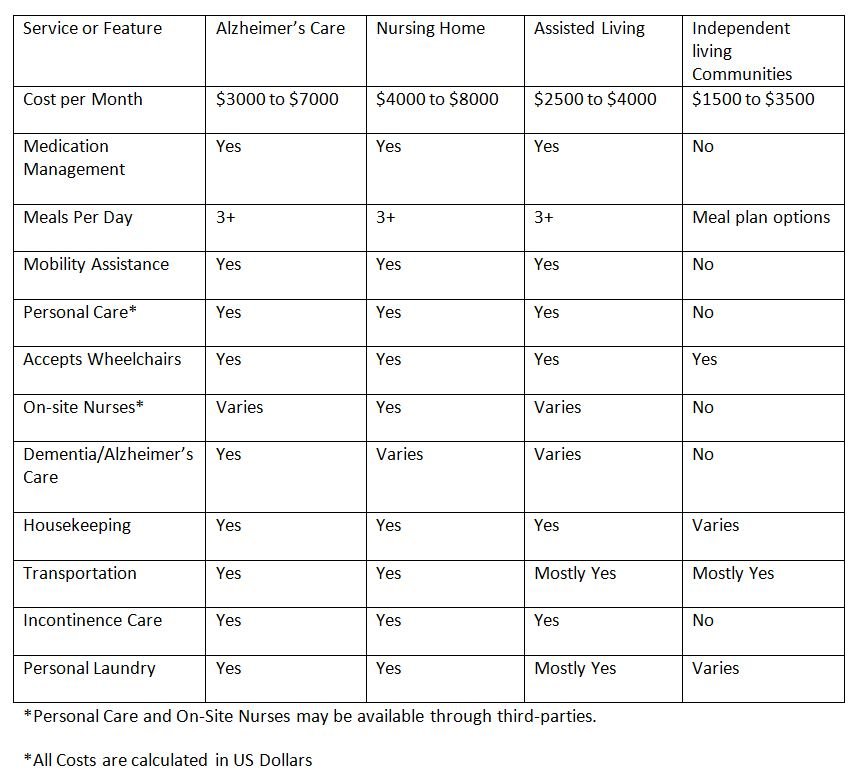
Senior Housing Options Comparison

The graphic will help lay out the approximate costs for each different type of senior care and living services.  Families can use this information to better plan for their needs.  It details approximate costs, types of services included, and whether each type of care includes things like medication management, personal care, transportation, and much more.  Knowing the needs of each senior helps pick the best level of care that fits their preferences and care level.

Senior Housing Options Comparison

How To Find A Retirement Community

As you or a loved on is getting ready to retire it’s a good time to start considering your living arrangements during retirement.  Retirement communities are fast becoming a hot spot for active retirement lifestyles for seniors of all levels of independence and health.  While traditionally retirement homes were just for seniors that needed care active retirees are joining them as the benefits go far beyond help with medications and care.  One of the most popular reason seniors are flocking to retirement communities is to stay active, stay social, and avoid becoming isolated.

Look For Resort Style Living

Retirement communities are not nursing homes and can be fun vibrant places to live.  Look for retirement communities that have amenities such as on-site hair salons, hot tubs, pools, restaurants, or craft rooms that allow you to explore your artistic side.  This makes it so your new home feels like a never ending vacation.

Look For Lifestyle

The best communities are those that give you the same freedom as you have at home.  If you have a dog or a cat you’ll want to make sure the community you choose is pet friendly.  Another consideration is if you’ll have the ability to have a child, grandchild, or other family member move in for more than just a few weeks.  There are also considerations for things like having plants, a garden, or even an outdoor grill on your balcony or patio.  Carefully consider what hobbies and activities you love that you’ll want to keep doing at your retirement community.

Look For Actives & Recreation

In addition to having built in social interaction look to make sure your retirement community has activities and plenty of recreation close by.  The retirement community you choose should have a calendar of events, activities, and even some crafts.  In addition you’ll want to make sure your favorite types of recreation are close by.  If that means you’re near a golf course or a bowling alley make sure there’s one nearby.

Look For Good Weather

As we retire most of us aren’t excited about shoveling feet of snow all winter long.  Many seniors are moving to retirement communities in warmer states such as Arizona.  With great retirement communities in picturesque locations such as Sedona, Mesa, Peoria, Youngtown, and Surprise, AZ seniors are spoiled for choice.

Look For Hospitals & Medical Care

Quality medical care and access to emergency services is a must for all of us no matter our age.  For seniors it’s a good plan to choose a retirement community that’s near good doctors, clinics, and hospitals.  This makes the travel time less to go and come back from appointments and eases worry about where to go if you need some help.  If you have a need of specialist doctors you’ll want to make sure some are nearby your new retirement community home.

Look For Continuing Care

While many retirement age adults have no need for services such as assisted living or memory care knowing the community offers them is a benefit.  Making the transition when or if the need arises is more simple if your community offers the more skilled levels of care and nursing.  While you likely don’t need it now planning for the future makes it more simple and less stressful should it become helpful.

Arizona Retirement Homes

If you are already searching for retirement homes in Arizona you clearly already know that Arizona most likely the best place to retire in the United States.  SLS Communities has multiple locations in the state of Arizona which offer Independent Living, Assisted Living, Memory Care, and Home Care Services.  All services are custom tailored to each resident to meet their needs and respect their independence.  Our staff strives to provide the most welcoming and compassionate senior care services anywhere.  When you or a loved one is looking for a place to retire, consider SLS Senior Living Services in Arizona. For more information or to schedule a visit at one of our locations please call 480-348-0300.

Written by webtechs

How To Move A Parent With Dementia To Assisted Living

To move a parent with dementia to assisted living smoothly involves a few key steps. These steps are knowing when it’s time, and introducing the new home in stages. We all know that moving a loved one into a assisted living can be stressful for everyone. It is possible to make this change without excessive stress, discomfort, or drama. This post will give tips on how to move a parent with dementia into assisted living smoothly.

There are some signs which will help you decide when it may be time for assisted living.  Dementia assisted living or memory care as it is commonly known is a safe environment for seniors with memory challenges.  The grounds are restricted access and also help keep seniors from wandering and getting lost.  In addition to helping keep seniors safe staff assists with taking medications, personal care, and all other tasks that a senior might need.

Steps To Move A Parent With Dementia To Assisted Living

When it’s become clear that your parent has reached a point where they need assisted living or memory care use these steps to researching the best option.  Caring.com maintains an extensive directory of care facilities who provide specialized care for dementia.  There are additional steps you can take to help manage your parent’s memory care.

Step 1. The Alzheimer’s Association

Most cities and towns have local Alzheimer’s resources that’ll help both you and your parent. Visit their site to learn more about how they can help you with emotional and social support during this time at Alzheimer’s Association.

Step 2. Learn About Dementia

Without knowing what dementia is, what the stages are, or what symptoms to watch for you’ll have no idea if your parent is safe.  It’s important to understand the disorder and provide care when it is needed but respect their autonomy until they cannot care for themselves. Read about the seven stages of dementia.

Step 3. Start Looking For Care Early

If you’ve noticed signs that your parent has dementia it’s a good idea to start looking for potential assisted living and memory care communities early.  It’s always less stressful to do the searching and visits when there isn’t a crisis.  This way when the time comes you’ve already got a great place picked out and can move forward when needed.

Step 4. Find A Geriatric Care Expert

These specialized care coordinators understand the needs of seniors with dementia and can help find the best communities for them.  When there’s an unbiased expert in the room seniors won’t be as focused on if their child is “trying to put them in a home”.  Instead they’ll likely see that there’s a legitimate need for the move and accept it more easily.

Step 5. Hire A Lawyer

When your parent has dementia and enters care facilities many times children will need to have power of attorney rights.  Lawyers can produce the needed paperwork for you to take care of your parent’s estate and see that their finances are taken care of properly.  Seniors should be involved in this process to ensure they feel in control of their care.

Step 6. Take A Quick Tour

It’s important that the senior see the new home they’ll be moving to.  You should schedule a time for them to visit the community but not stick around too long.  It’s important that the first visit not feel like you’re getting ready to drop the senior with dementia off.  Try to maintain a positive element in conversation and point out the praiseworthy elements of the community that you know your loved one will like.

Step 7. Introductions & Making Friends

If your senior agrees to a meal or activities at the community you’re considering ask the assisted living staff to pair you with some of the most outgoing and friendly seniors in their community.  Introduce your parent for who they are and what they do best, not that they are considering living there.  When people start making friends, new places become less intimidating.

Step 8. Provide A Temporary Reason

Virtually all seniors would rather stay home and it is even harder for seniors with dementia to understand why a move would be necessary.  A great technique is to introduce a practical reason living at home isn’t possible, temporarily.  Temporary reasons you give might be along the lines of the house needs to get fumigated, painted, or needs extensive construction. This will be a logical reason for them to move temporarily and give them time to enjoy an active and compassionate community.

Staff in these situations are typically informed of the reason the senior is living with them.  This makes a more cohesive transition into assisted living and even the most resistant seniors many times realize the benefits of assisted living after having given it a “test drive” and accept it as a permanent solution.

Step 9. Keeping It Positive

During visits it is normal for loved ones living in assisted living communities to ask about when they are going home. It is important to avoid talking about how they are living there now.  Instead it is much more constructive to focus on asking questions about their new experiences such as food, new friends, and activities.

Step 10. Personalize The Room

It’s easier to make a change to a new home when it resembles a place you’re already comfortable.  Families can personality, decorate, and work with staff to ensure the new living arrangement is as much like home as possible.  These efforts go a long way in helping seniors with dementia feel comfortable in new surroundings.  Some family members have some doubt about making an assisted living room look like a senior’s home.  While it might seem less than honest when it comes to dementia the truth isn’t always constructive.

Step 11. Quick First Visit After Move

Once your parent with dementia has moved into the assisted living community make your first visit short but positive!  It’s common for seniors to ask when they will be returning home.  It’s important to avoid discussing that their new living arrangement is permanent. Redirect conversation if possible to the positive attributes of their dining, activities, and even new people they’ve met and made friends with. After your visit you might call and ask if your parent was excessively upset by the visit.  If so plan a little more time until the next visit to allow them to accept their new surroundings.  Then you can set up a more regular schedule for visiting them in their assisted living community.

Knowing When It’s Time

Caregivers are best served by watching for legitimate signs that dementia is setting in and avoid using arbitrary guideposts to make decisions.  It is a confusing and difficult decision to move a loved one or parent into assisted living or memory care.

There are situations where people say that it is time to move them if a spouse or parent forgets how to use the toilet, or forgets names of loved ones.  There is a chance seniors will never experience these signs yet still be living with dementia.  That means there is a chance that you and your loved one might be holding on and trying to care for a love one with dementia.  Moving the spouse or parent with dementia to assisted living will benefit everyone involved.

Signs Assisted Living May Be Needed

Read through the headings and see if you recognize any behaviors or signs that assisted living and memory care might be the best living situation for your spouse or parent.

1. They are no longer safe at home

The main reason that many families choose to move a parent to assisted living is when the senior is no longer safe.  This happens when there simply aren’t enough resources to guarantee the senior’s safety.  This is typically caused by memory deficiency and you should use the following list to evaluate their safety.

There are a number of questions you should ask yourself when evaluating your senior loved one’s safety.  Ask yourself the following questions to gauge if assisted living or memory care is needed.

  • Is the senior able to take prescriptions according to directions?
  • Are they able to prepare and store food safely?
  • Do they leave oven or burners on after cooking?
  • Are they eating regularly and not losing or gaining weight?
  • Have they fallen recently? Have they fallen repeatedly?
  • Is there any physical aggression towards people or pets?
  • Do they wander away from home, or get lost?
  • Is there a chance that the loved one is being abused?
  • Do they drive without a license or against doctor’s orders?
  • Have they been victimized by scams or likely to be?

When you start realizing that your loved one might not be able to safely care for themselves it is time to consider how assisted living might be the very best living condition for them, and for the people caring for them.

2. When Seniors With Dementia Are Bored

One sign that your loved one might be suffering from dementia is if they are following you around, asking what you are doing or are going to do.  This is clear sign they are lacking stimulation. Everyone needs some kind of daily activities which entertain, challenge, and offer us creative outlets.  Assisted living facilities specifically choose the best types of activities which cater to groups of seniors with dementia to stimulate them in meaningful and engaging ways.

People want purpose in their day.  They want something to get up for that is for them and about them.  Seniors not provided with activities and meaning decline much faster than their counterparts and it can be a major undertaking for a caregiver to provide the necessary stimulation.

3. When Caregivers Are Burning Out

Caregiver burn out is a serious issue for the quality of care seniors get, and for the mental health of the caregivers.  “Burn out” is an term that covers a lot of different difficult situations for care partners.  Burn out can be emotional, physical, or both.  Some caregivers become socially isolated, emotionally exhausted, and might feel like they are losing themselves.  Other caregivers are simply exhausted by the physical exertion of caring for their loved one.  This is common among spouses and with physical exhaustion comes a cost at the caregiver’s own health.

Caregiver Guilt & Stress

Seniors and families never ask for dementia but it is a reality for many people.  Feeling burdened by the workload of caring for the senior and resenting it will leave caregivers feeling guilty, especially when they are unable or poorly equipped to do the job.  Guilt is a feeling which is normal when something is done wrong.  When a caregiver is upset that they aren’t able to go be social and they must fulfill their caregiver roll they might feel guilty for having these thoughts. It isn’t something to feel guilty about.

Find Affordable Assisted Living Services in Arizona

Find affordable assisted living in Arizona with SLS Communities.  We proudly operate assisted living facilities in the Phoenix Valley in Mesa, Surprise, Peoria, and Sedona.  Ultimately the ball is in the court of spouses, children, and doctors when it comes to deciding the right time to move a senior into assisted living or memory care.  There are a lot of signs that can be watched for and there are seven stages of dementia that can be used by doctors and families to know when the time is right.   For more information about our Assisted Living Communities or Memory Care Communities please give us a call.  We make every effort to ensure that the transition for seniors with dementia into our communities is welcoming and positive.

Call for more information or a tour of our facilities today – 480-348-0300

Written by webtechs

Best Retirement Communities For Active Adults

How Seniors Can Keep Healthy This Summer

The best retirement communities for active adults have great floor plans, a strong sense of community, wide variety of activities, and easy access to entertainment, medical care, and recreation.


As an active adult you’re looking to stay active but also enjoy a low maintenance lifestyle.

Independent living communities are the perfect solution for many active seniors.

In this post we will explore what you should expect and how to choose the right community.


Best Retirement Communities Include

The very best retirement communities for active adults have some hallmarks which you should watch for.  Ensuring there are these things will help you find a place that you fit into and can stay active.

Active Adult Communities Should:

  • Have plenty of activities to choose from to get out the door and get moving.
  • The apartments and floorplans should be laid out well and comfortable.
  • Foster a sense of community that’s very strong and draws seniors into the fun.
  • The location is a reasonable distance to entertainment, recreation, and medical care.
  • The community provides you with a low maintenance lifestyle to free up time for fun.
  • The best options are those that include resort options like pools, theaters, and more.
  • Some prefer communities that are 55 and older while others like a mix of ages.

These are the key things to consider when visiting retirement communities.  Ensuring they have these thing will help you choose a place you’ll love to live in and stay active.

Selecting The Best Retirement Community

Retirement communities dot the map and exist in every region of the country.  Some active seniors want to have more days of sun and warmth a year and head south to places like Florida and Arizona.  These warmer places give seniors a snow free winter that’s got loads of days for outdoor activities.  The first step is to decide which region of the world you’ll be most comfortable and get as many days of fair weather to bike, golf, kayak, or any active outdoor activity.

Keep in mind your favorite activities and ensure that the community you choose is close to places you can stay active.  If you’re an avid cyclist you’ll want plenty of roads or trails which are bike friendly.

Bike Trails, Golf & Entertainment

The Phoenix Valley is full of amazing opportunities for cyclists, golfers, and entertainment for any taste.  Parks are full of bike lanes and well-manicured landscaping.  And with nearly 300 days of sunny weather it is a haven for the golfer.  The valley is packed with world class golf courses and driving ranges.

When it comes to entertainment in the state of Arizona, you’ll be spoiled.  There are many movie theaters, art galleries, sporting events, and other culture events and museums.

With this variety of options for active adults there’s no surprise that Arizona is quickly becoming America’s favorite retirement destination!

Tour Active Adult Retirement Communities

The best way to judge if you’ll love a retirement community is to visit it!  Taste the food, walk around the property, get a feel for what is close by that you’ll enjoy seeing and doing.  While you can narrow down some of your options online the best way to get a feel for community is face to face.  Consider a few of the following active adult retirement communities below.

1.      Canyon Winds

Located in the vibrant and active city of Mesa, Arizona; Canyon Winds Retirement Community is the newest and one of the most exciting opportunities for active seniors.  The upscale retirement living community offers independent living that fits the needs of the most active seniors.  With resort style dining, spacious apartments, a fitness center, theater room, swimming pool, spa, and housekeeping services you’ll have plenty of activity while staff sees to your cooking, cleaning, and laundry.

2.      Sedona Winds

Nestled in the mountains of Arizona Sedona Winds Retirement Community is one of the premier locations for active adults to enjoy retirement. In addition to stunning views of wildlife and nature Sedona Winds is close to cultural centers, medical offices, golf courses, restaurants, shopping and much more!  Your independent living apartment is outfitted with a full kitchen, balcony or private patio, and there’s a hair salon, barber shop, heated pool, and much more.

3.      Chaparral Winds

With many golf courses close by, loads of shops, and plenty of restaurants there’s no shortage of activity to be had at and near Chaparral Winds Retirement Community.  Living in this community will include chef prepared meals, access to a swimming pool, hot tub, billiards, computer room, transportation, and the help with laundry, cooking, and cleaning you expect from your retirement community.  Allow us to take care of the chores and details while you stay active and enjoy what Arizona has to offer!

4.      Desert Winds

Desert Winds Retirement Community is located in Peoria, Arizona.  Peoria is home to great festivals, arst and culture, plenty of golf courses, public parks, baseball spring training, loads of outdoor activities, shopping, restaurants, and access to quality medical care.  Active adults love this community as it provides the resort style comforts of a swimming pool, hot tub, loads of activities, fitness room, and much more.

Schedule A Tour at An Active Adult Retirement Community

When it comes to choosing a retirement community, seeing is believing.  It’s important to go and see the condition of the communities you’re considering, meet the staff, taste the food, and get a feel for where you’re considering living.  SLS Communities offers an active retirement lifestyle for seniors at 4 of their Arizona retirement community locations. 

For more information about scheduling a tour please call 480-348-0300.

Written by webtechs

Dealing With Aging Parents Depression

To deal with aging parents depression it’s important to ensure they’re taking medications, getting enough activity, sleep, social interaction, good nutrition, and they have a sense of purpose.

8 Best Ways To Deal With Depression In Seniors

We all go through upsetting changes in different stages of our lives.  However seniors have a tendency to experience more depression.  This is typically due to being retired and not having a daily rhythm that helps them stay active.  See to it that your parent or parents are following these guidelines to prevent or to recover from depression.

1. Taking Prescriptions

If your loved one has sought treatment for depression and has medications to help cope with and defeat depression it’s important they are being taken. In addition any other medications that are prescribed should be monitored to ensure their health is in tip top shape.  A lack of energy can also lead to depression.

2. Get Them Moving

Physical activity is important at every age, including when we retire.  Not only does physical activity help with depression but it also helps seniors live longer.  Great exercises for seniors include things like doing Tai Chi, walking, or climbing stairs.  To maximize the benefit of exercise it’s a great idea to get the senior into a group who gets regular activity.

3. Quality Sleep Is Key

The first step to great nightly sleep is not taking naps in the daytime.  While this is temping for just about any of us, it will make it harder to go to sleep and stay asleep at night.  Lots of seniors get off their sleep rhythm whenever they retire.  Knowing there’s no alarm that’s going to sound to get to work at 8 makes it seem ok to stay up all night watching TV.  This type of habit aggravates depression and should be avoided.

4. Staying Social

It’s all too easy to isolate when we retire.  But as social beings we still need to have interaction.  Being around other people, especially peers, helps us feel connected.  It also helps us eat better, avoid depression, and simply live better. Great ways to stay social for seniors are community events, visiting family and friends, along with taking part in group outings through communities and church groups.

5. Eating Well

Diet has an impact on how all of us feel, and it’s still true for seniors.  Eating foods that are excessively starchy, full of sugar, or contain saturated fats feed depression.  Offer seniors foods that are rich in fiber such as lean proteins, whole grains, vegetables, and fruits.

6. Having Purpose

Having something to get up for is a big part of living.  When we retire there’s not always a job to go to or chores to take care of.  It’s important for us to feel like there’s a reason to get out of bed, groom ourselves, and get out the door.  Doing so makes us more resilient to feelings of depression.  For seniors great ways to have purpose is to volunteer, get involved in hobbies such as yoga, tai chi, or even playing cards.  Another great approach is giving them a plant to take care of.  It gives them a chore that offers responsibility and meaning.

7. Talk To Professionals

Living with depression is no way to live.  If your parent or parents are suffering and none of these tips are helping, talk to doctors and other health professionals. Mental health professionals understand strategies and medications that can promote a better quality of life.  Keep an eye out for changes in behavior and decreased appetite.

8. Consider Assisted Living

Your healthcare professionals may suggest that your parent consider moving into an assisted living community.  These communities help monitor prescriptions, have loads of social activities, promote an active lifestyle, and provide well balanced meals.  Staff also has the ability to help monitor changes in appetite and mood.

Assisted Living Services

If your parent isn’t sleeping, eating, or getting out there’s a good chance they are suffering from depression.  It can be a big job for adult children of seniors to manage their jobs, children, and homes and take care of their senior parents.  Assisted living communities offer the care they need and a chance to overcome feelings of isolation to beat depression.  In addition the activities, well balanced meals, and help with prescription medications all help support a better mood and minimize depression.  Call to find out more about assisted living communities we operate in Arizona.

Call 480-348-0300 or Contact Us

Written by webtechs

Easy Crafts For Seniors With Dementia

If you’re searching for “Easy Crafts For Seniors With Dementia” this article will help.

Browse activities that will be fun and engaging for your loved one, spouse, or the senior you’re caring for.

Although you may have someone with Alzheimer’s, it is important to have them engage in life, and still have fun. However, there are many Alzheimer’s patients who don’t have the ability to enjoy the activities that they once did. Yet, with the use of your imagination there are different activities one can create themselves, they are the DIY (do it yourself) activities.

Easy Crafts For Seniors With Dementia

For starters, try different activities which do not have a specific (right or wrong way) of doing them, but yet, they have to be satisfying, filled with fun, and help to encourage self-esteem. In fact, using activities such as this can sometimes be the best alternative to taking medications that are intended for behavioral issues, depression, or to reduce agitation.

Safety Comes First

It is also important that the activities you come up with will not be harmful to anyone. You yourself should be able to judge what will work the best for you are probably the one that knows them the best. For instance, some seniors may have the habit of putting things in their mouth or even eating them. In cases such as this, the best route to take would be to eliminate things that can be a choking hazard or things that may damage their teeth.

Remember to take into consideration those who may be in the habit of tying strings around their fingers, for it could end up being their neck at some point (cutting off their circulation). Here are 10 activities that are filled and are sure to satisfy your loved one who has Alzheimer’s, which you yourself will be able to make. With only your imagination and a bit of creativity, simple household items can be made into safe and fun activities.

1. Clip some clothespins (colorful ones)

Mini clothespins or full size either can be used. Simply give your loved one something like a wire clothes hanger, basket, or anything that is safe that they can clip the clothespins to and watch them amaze themselves with all the wonderful colors.

2. Flower arranging

Arranging flowers is a good activity for seniors who previously enjoyed making flower gardens, etc., so take them back in time by letting them create beautiful arrangements. All you need is some florist foam, plastic vase, and artificial flowers.

3. Attaching pipes & fittings

There are a lot of seniors who enjoyed the handyman work they used to do around the house, and an activity consisting of something they once enjoyed can do wonders for their morale and their self-esteem. That is why letting them participate in an activity that holds a chance of bringing back a memory, or memories makes the perfect kind of activity for them.

All you need are several different lengths of PVC piping and some fittings (all of which, doesn’t cost much at all), get a few of the elbows and a few T-joints at the hardware store, and if you ask them, they will usually cut them for you.

4. Sorting coins and/or parts from the hardware store

Another great activity for seniors is to give them several different hardware parts, such as washers, bolts, and nuts, and ask them to sort them up for you. They may also get interested in sorting large amounts of loose coins, this may take them back to a time when they had to manage their own finances.

5. Let them enjoy homemade play dough

Any age groups can have fun and relax playing around with play dough and modeling clay. Pick-up a few cookie cutters and play dough and just watch how much fun your senior has. Here is a recipe to make your own non-toxic play dough, just remember not to store it in your refrigerator.

Try mixing in a few drops of essential oils (there are many different scents you can purchase), this can be a very relaxing activity.

6. Keeping a beat, using a homemade shaker

For this activity all you need is a plastic container with a good fitting lid. Put several dry beans or pasta in the container and you have a music shaker. You can either play some music for them or make one for them to shake with you.

7. Use picture cards for sorting

This calls for two copies of each picture you think your senior would enjoy, they can be laminated with clear tape if you want. Then you will have your senior mix and match or sort them, giving them tons of entertainment.

However, they should be about the size of playing cards, so they can hold them in their hand.

8. Let them make a scrapbook

For this activity you will need a notebook (can be bought for very little), magazines, catalogs, newspapers, scissors (the safety kind), and glue stick. Have your senior look through and cut out the pictures that interest them and then help them to glue them in their new scrapbook.

9. Party (paper) cups make for fun stacking

Pick-up some of those inexpensive party cups or fancy paper cups if you want, then have your senior help with cleaning up by asking them to stack or sort the cups.

10. Fun with magnetic letters

Use magnetic letters on a metal baking sheet and see what fun words you and your senior can come up with together. Another way to use magnets is to just have fun matching up the different shapes and colors of various magnets.

Benefits of Social Activities for the Elderly

Taking the time to do these crafts in groups where seniors can be social offers many important benefits.  Some of these benefits include healing more quickly, delaying or even preventing some diseases, and the psychological benefit of having continued interaction with other people.

Better Emotional Health

By spending time with others doing crafts it gives seniors a chance to make new friends or tend to existing ones.  These interactions help improve our mood and therefore helps avoid dipping into depression.

Better Physical Health

When humans interact together they are generally more physically active.  This physical activity, however lite in nature, does help keep us healthier than surfing the sofa watching TV.   In addition if refreshments or meals are served we tend to make better decisions for what to eat, and eat more of it in social settings.

Improved Cognitive Functioning

When you interact with others and especially if you’re using your mind to be creative you’re improving your overall cognitive functioning.  Mental activity keeps the mind sharper and helps delay or even prevent dementia and Alzheimer’s.

More Restful Sleep

Studies have shown that people who spend more or extended periods of time in isolation tend to have more trouble sleeping.  Social activities tend to help us sleep more easily and get more restful sleep.

Improved Immune System

Those who socialize tend to have better immune systems.  This is in part simply from being more active but also is better from getting better rest and making better dietary choices.

Longer Healthier Life

With better dietary habits, better sleep, improved cognitive function, and physical health we live longer and more healthy lives.  Social activities and craft projects keep our minds engaged and help tend to our social needs.

SLS Memory Care Services

The professionals at each of our memory care facilities is trained to care for seniors with dementia compassionately and appropriately.  Our team understands intimately the challenges that seniors face when dealing with dementia and can help keep them engaged with activities that stimulate the mind yet are safe.  If you’re interested in what SLS Communities memory care services can do for your spouse, parent, sibling, or loved one please give us a call at 480-348-0300.

Written by webtechs

When Is It Time For Assisted Living?

It is time for assisted living when seniors show aggression, have sundowners, aren’t safe alone, care needs increase, or when their caregivers are becoming overwhelmed.


Making the decision to move a loved one to assisted living isn’t an easy decision.

There are signs and symptoms to watch for both in the senior and their caregivers.

We will help you understand more clearly the things to watch for to know when it’s time.


When Is It Time For Assisted Living?

Assisted living is a solution for families and seniors for when care needs exceed what can reasonable be given in the home.  Caregivers compassionately give of themselves and their time to care for the seniors they love.  Knowing when to admit the burden has become too great and avoid becoming ill from the stress is a hard and personal decision.

Care Needs Increase

Most seniors can use a little help with the heavy lifting.  But there comes a point where they need help more than their loved one’s can provide.  If you’re started to wonder if the senior’s safety is at risk or the people caring for them are burning out, it might be time to discuss a move to assisted living.

Senior Wandering

Humans are curious explorers and this doesn’t stop when someone gets dementia.  The problem comes when they aren’t sure where they are and become lost.  They can also fall and get injured while wandering.  This can happen in the blink of an eye while you change the laundry or use the restroom.

Aggressive Behavior

One of the most obvious signs is when a senior becomes physically or violently aggressive.  Family or caregivers may start to feel hurt, offended, and start to resent the senior when they experience this aggression.  This is a clear sign that the senior needs to be considered for assisted living.

Experiencing Sundowners

Sundowners is described as a senior who experiences behavior that’s very aggressive later in the day.  It is a common component of dementia.  When seniors begin responding or acting aggressively later in the day it can be very hard on caregivers.  This can push the needs of the senior past what family can provide.

No Longer Safe Alone

Seniors with dementia are forgetful by definition.  That means they may start cooking and turn on the stove or oven and forget about it.  This obviously can start a fire and be very dangerous.  Other ways seniors become unsafe is if they can’t navigate the home safely with stairs, they forget to take medications, or they are unable to drive safely.

Caregiver Burnout

The people who care for seniors whether it be family or paid caregivers can reach a breaking point with strain.  If the senior’s needs or aggression becomes too high it can be bad for the caregiver.  When caregivers are showing signs of strain like depression, loss of interest, or other common signs of stress it’s important to realize that the senior may be better cared for in an assisted living community.

Caregiver Stress Signs

Caregivers need to be observed nearly as much as seniors with dementia.  There are some common and disturbing symptoms of caregiver stress.  These include thoughts that won’t go away, avoiding people or experiences, hypervigilance, and anxiety that disturbs their life.

Causes of Caregiver Stress

Clearly caring for someone with dementia takes dedication and effort.  In addition to these pressures normal sleeping and eating patterns are disturbed for caregivers. When a person is constantly focused on caregiving and needs to be alert it affects a person physically.

When Caregiving Hurts

In the case where the caregiver is an adult child or especially when it’s a spouse of similar age the emotional, mental, and physical demands can easily become too much.  If a senior falls in the shower and the caregiver is unable to help them, it is a clear sign that assisted living is a better and safer choice.  Not only for the senior but also for those who are striving to care for them and suffering from it.

Caring For The Caregiver

While it’s obvious the senior needs care the caregiver is often overlooked.  With seniors near constant need for care of one kind or another it’s all too easy to neglect caring for oneself as the caregiver.  It is of paramount importance for the caregiver to stay healthy.  It enables them to live better and care for the senior better.

Take A Break

If it’s become clear as a caregiver that you’re burning out, take a break.  Have other family members come and see to the needs of the senior.  Another option is to organize a short stay in a care facility.  Either way will give the caregiver time to see to their own needs such as mental health.  Some caregivers benefit greatly from individual therapy and/or support groups.

Plan For Assisted Living Early

One of the best things a senior and their family can do is prepare a plan for when the move to assisted living should occur.  This relieves the caregiver of the burden of making this decision.  When early signs of dementia are clear it is a perfect time to have this conversation.  Make selections about which assisted living community is best.  Have all of the paperwork done.  It will be much easier to make this transition with a plan in place and the paperwork already done.

Arizona Assisted Living Communities

If you live in or want to retire to Arizona, you’re not alone.  With year round sun and mild winters Arizona is the perfect place to choose assisted living. SLS Communities offers Assisted Living Services at multiple locations near the Phoenix Valley and Sedona, AZ.  We proudly provide the very best of assisted living with compassionate care, chef prepared meals, and apartment style living.  Learn more about why so many seniors call an SLS Community home.

Call 480-348-0300 or Contact Us

Written by webtechs

How Do You Talk To Someone With Dementia?

To talk to someone with dementia choose a quiet location, go early, have topics, speak calmly but clearly, avoid excessive questions, laugh about misunderstandings, and show interest with body language.


It is heartbreaking to see loved ones struggle with dementia.

You can still have positive interactions with the right approach.

We will show how to talk to someone with dementia in this post.


How To Talk To Someone With Dementia

Learn how to speak, what to say, active listening, and communicate better with someone with dementia.  Whether it’s a parent, grandparent, aunt or uncle being able to enjoy a visit with better communication benefits seniors and their visitors.

Preparing To Talk

  1. Plan enough time to have a relaxed conversation that’s not rushed.
  2. Try to choose a time of day that is best for the senior.  For many this is early in the day when they have better clarity and energy.
  3. Make sure their needs for food, medications for pain, or other needs are met before starting to talk.
  4. To have better talks with someone with dementia choose a location without excessive distractions.  This means away from TV and radio.
  5. It’s important to make sure you have the senior’s full attention before you launch into your conversation.
  6. Sit close enough that you’re easy to hear but not so close you’re invading personal space.  Ensure you’re making and maintaining natural eye contact.
  7. Show your mood through relaxed body language that’s open and non-threatening.
  8. Consider what topics you bring up.  Having some uplifting topics in advance may help.  Also choosing things to talk about from your surroundings can help encourage conversation.

How To Listen

  1. Be an active listener.  While you’ve likely heard a story or two before; remember that you’re visiting them to enjoy time together.  Be encouraging about what they are saying and listen with intent.
  2. Be mindful of how they are feeling as you’re listening.  If they’re struggling to find a word or complete a sentence encourage them to find a different way to tell you about their story or idea.
  3. When or if you’re confused about what they are saying try to state as much of what you have understood.  Watch carefully as you paraphrase what you’ve heard to see if they feel understood or frustrated.
  4. Don’t shut down sad feelings or thoughts.  If you dismiss them they feel uncared for and alone.  There are times where simply listening is the best thing you can do.  It validates them as a person and makes them feel heard.
  5. Give them time to collect their thoughts and respond.  While the back and forth with younger people is lightning fast people with dementia take longer to sort out what they want to say and find the words that best express their thoughts.  Try not to interrupt while they work through how they want to respond or express themselves.

How To Talk

  1. Speak more slowly and allow them to process between sentences.  Wait for them to respond to show respect for their contribution to the conversation.
  2. You’re bound to have a few misunderstandings in the conversation.  Ensure that you keep the mood light and laugh at these. Make sure you are laughing at the misunderstanding and they don’t get the feeling you’re laughing that them.
  3. Get the senior speaking with more than just you.  By including others in conversation with them you reengage them in social interaction.  This helps reduce feelings of isolation or exclusion.
  4. Use a calm and clear voice to communicate.
  5. Speak simply and try to use short sentences.
  6. Try not to raise your voice or be aggressive.
  7. Have a conversation instead of asking question after question.  Allow them to speak and steer the conversation towards positive topics when possible.

What To Talk About

  1. Try to ask questions that are easy to answer.  Instead of open ended questions such as “what would you like to do today?”  Try to suggest an activity such as “Would you like to take a walk in the garden?”.  This makes it easy for them to answer with a “yes” or “no”.
  2. Avoid questions that are complicated or asking too many questions. If the senior cannot come up with an answer it puts their limitations in the spotlight and can make them feel depressed and frustrated.
  3. Wait for answers to questions you ask.  Don’t overwhelm them with too much at one time.  If you ask about a walk in the garden, wait for an answer.  If they didn’t want that suggest another activity and wait for a response.
  4. Overcome confusion by breaking down a subject into smaller concepts.  Follow through the conversation slowly by discussing each point that leads to a larger idea or conclusion.
  5. Be aware of if they are tired from the exertion of conversation.  Adjust the duration of your visits to match the ability level of the senior you’re visiting.
  6. Redirect confused thoughts to discover unmet needs.  For example, if a senior with dementia talks about needing to get ready to go to work they might not feel a sense of purpose.  This means they need more activity or stimulation to feel active and involved.

Mind Your Body Language

  1. As dementia progresses how you look as you say things becomes increasingly important.  In later stages it becomes a larger part of the conversation than the actual words being shared.
  2. Ensure that your facial expression and body language matches the emotions you’re trying to exhibit.
  3. When it feels like a good situation putting an arm around someone or holding their hand can convey your intentions to comfort more than any words you could offer.
  4. Ensure you don’t stand over someone or too close.  This can feel threatening or intimidating. This will shut down their desire to have an interaction.  Instead try coming down or lower than their eye level to put them at ease.
  5. Avoid exhibiting strained facial expression or quick movements.  Both convey a sense of distress, pain, or discomfort that a senior with dementia will not likely miss.

Phoenix Valley Memory Care Services

When you’ve got a loved one with dementia you want to know their needs are being met.  SLS Communities offers Memory Care services that see to the needs of seniors with dementia in comfortable and safe surroundings.  Our highly trained and compassionate staff sees to daily hygiene, prescription medications, meal preparation,  and strives to keep seniors engaged with activities.  For more information about our Memory Care services in the Phoenix Valley please call 480-348-0300 or click here.

Written by webtechs

Seven Stages Of Dementia

If you’re searching for “dementia stages” or the “stages of dementia” this article will help you understand this condition better. From the early stages of dementia through the end stage of dementia you’ll learn about how you can tell and what actions might be considered.  Most people have heard of dementia but don’t realize there are seven stages of dementia or know what the signs of symptoms of dementia are.

Seven Stages of Dementia

There are seven stages of dementia under the global deterioration scale which are all characterized by different levels of memory loss and ability to function without assistance.  Families and physicians are able to tailor their approach for care of these individuals by identifying which stage they are in.While many times it is simplified into “early stage”, “middle stage”, or “late stage” dementia there are finer points that change the way doctors care for these seniors.

The stages start with 3 stages which are categorized as “no dementia” and include healthy.  This scale is most applicable for seniors suffering from Alzheimer’s disease, as other types of dementia will not always include memory loss.

Stage 1 Dementia

Stage 1 dementia is characterized by healthy people with no signs of any dementia, no memory loss, and are functioning normally.

Stage 2 Dementia

Stage 2 dementia includes people who normally forget things and is usually caused by natural aging. These people will forget where they put things and names of casual associations.  Symptoms are mild and rarely noticed by doctors or even loved ones.

Stage 3 Dementia

Stage 3 dementia is described as increased forgetfulness, decreased performance at work, and slight difficulty concentrating.  Stage 3 individuals will have more trouble finding words and may get lost more often.  This stage is usually noticed by loved once as marked cognitive decline.  Stage 3 lasts about 7 years before the onset of early stage dementia.

Stage 4 Dementia – Early Dementia

Stage 4 is considered “early dementia”, and is described as having trouble remembering recent events, increased difficulty concentrating, trouble traveling alone, and problems managing personal finances.   Many people who are struggling to handle complex tasks correctly or efficiently might be in denial about their decline.  This leads to decreased perceived self worth followed by decreased social interaction.  Physicians are able to clearly diagnose this stage through interviewing patients in exams.  This stage lasts about 2 years.

Stage 5 Dementia

The fifth stage of dementia includes people who have major memory deficiencies and need some help with their daily activities.  These activities may include preparing meals, bathing, and dressing. Memory loss in stage 5 is more pronounced and will likely include major relevant aspects of life.  People in stage 5 may forget their phone number, home address, and might not know where they are or what time it is.  This stage lasts usually about 18 months.

Stage 6 Dementia – Middle Stage Dementia

As the second stage of “middle stage dementia”, stage 6 is describe as people who need extensive help to carry out daily activities.  These seniors will not likely remember recent events and will start to forget the names of close friends and family.  These people may only be able to remember details from their earlier life.  Finishing tasks becomes more difficult and they also might not be able to count backwards from 10.  Incontinence is also a common issue at this stage.  Additional characteristics of stage 6 include: compulsions, anxiety, agitation, personality changes, diminished speaking, and having delusional beliefs.  The average duration of stage 6 is 2.5 years.

Stage 7 Dementia – Late Stage Dementia

The final stage of dementia is stage 7.  This is when seniors have no ability to communicate or speak.  They require round the clock assistance for activities including eating, using the restroom, and bathing.  Loss of psychomotor skills is common which includes the ability to walk.  This stage typically lasts about 2.5 years.

Phoenix Valley Dementia Care

If you have a loved one who’s suffering from dementia it can be a stressful experience to provide care for them.  As seniors progress through the stages of dementia the task can become a full time, round the clock job.  Our staff cares for dementia residents in our Memory Care Facilities in the Phoenix Valley.  Staff is on hand 24 hours a day, 7 days a week, and takes care of all of the various needs associated with the stages of dementia.  Residents are compassionately cared for and their ability levels are respected.  Click here for more information about our Memory Care Communities.

1 4 5 6 7 8